


From a party for Tucson’s gem dealers to a full camping festival, Gem & Jam has grown by bringing music, visual art, and a very particular crowd together.
Every winter, Tucson becomes a gathering place for gem dealers, mineral collectors, artists, and people who travel considerable distances to look at rocks.
It’s a natural setting for a party.
That was the original idea behind Gem & Jam, which began as a celebration for people attending Tucson’s gem and mineral shows. Over the years, the party evolved into a music festival where jam bands, electronic artists, visual art, and gem culture share the same grounds.
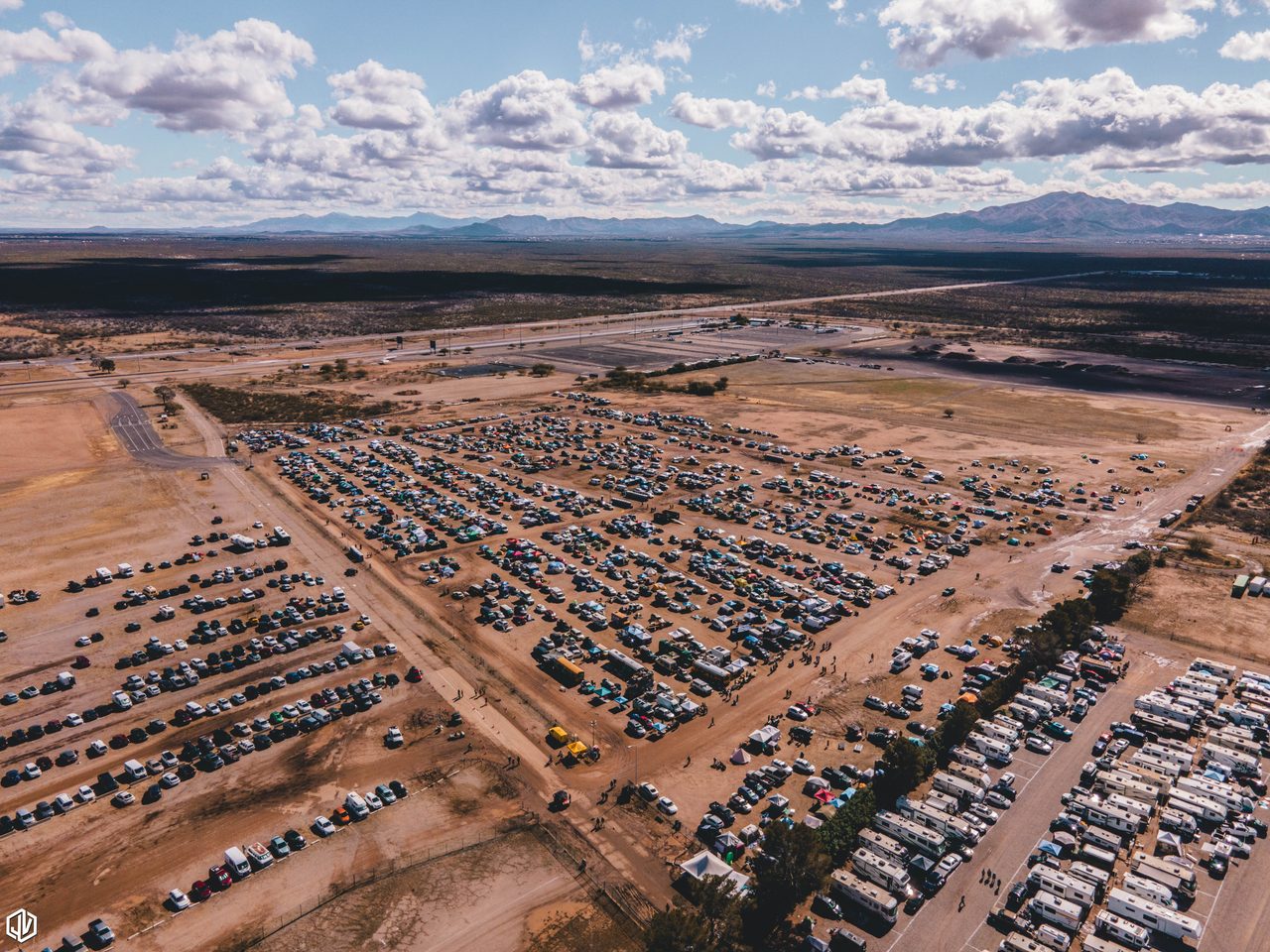
Josh Pollack, one of the organizers behind Gem & Jam, has spent much of his career helping shape that evolution. Now in its 17th year, the festival has grown from smaller venues around Tucson into a camping destination with multiple stages, art installations, vendors, and a returning community.
For Pollack, the goal was never simply to make the event bigger. It was to build the kind of festival he wanted to attend.


From Tucson’s Gem Shows to a Camping Festival
Pollack’s path into live events started with a love of music. “I really fell in love with music at a really young age,” he said.
In college, he interned at a booking agency and a record label while spending as much time as possible at concerts. He was drawn to the atmosphere surrounding live music: the dancing, the release, and the connection between people sharing an experience.
That interest eventually became a career producing events, including Gem & Jam. The festival’s roots in Tucson’s gem-show circuit gave it an unusual foundation. Rather than starting with a musical genre and building everything else around it, Gem & Jam grew out of an existing gathering of collectors, vendors, and artists.
Music became part of that culture, and the event gradually expanded. Early editions took place in smaller venues around town. As the festival developed, Pollack and the team moved toward a format that could accommodate camping, larger grounds, installations, and programming beyond the stages.
“I did kind of see this as the goal,” Pollack said of the festival’s eventual expansion.
The camping format changed what attendees could experience. Instead of arriving for a show and heading elsewhere afterward, people could spend the weekend on-site, moving between performances, artwork, vendors, and their campsites.

It also allowed the festival to develop a rhythm beyond the music schedule. People could return to the same gathering each year, reconnect with familiar faces, and make the weekend their own. For Pollack, that continuity has become one of Gem & Jam’s defining qualities.


Finding the Balance Between Music and Art
Gem & Jam has always occupied an unusual space in festival culture. Its audience includes jam-band fans, electronic music listeners, artists, gem collectors, and people who move comfortably between those scenes. Keeping them together takes more than booking a little of everything.
Pollack approaches lineup curation with an eye toward variety, but also toward whether an artist fits the festival’s overall character. Attendee requests matter, though they aren’t the only consideration.
He wants the weekend to offer different sounds and energies, allowing people to move between live instrumentation and electronic performances rather than spending three days hearing variations of the same thing.
That balance helps explain why the festival has maintained its connection to jam music while embracing electronic acts.
The visual art is equally important. Pollack described the festival’s art gallery as one of his favorite elements of the event. Unlike a conventional gallery, it’s part of an active festival environment, where visitors can spend time with artwork while remaining connected to the music happening nearby.
That relationship between the gallery and the stages gets at what makes Gem & Jam distinctive. The art isn’t simply decoration around the performances. It’s another reason to explore the grounds.
The festival’s origins in Tucson’s gem culture remain part of that identity, too. Gem dealers, visual artists, musicians, and festivalgoers bring different interests to the weekend, and the programming gives those communities room to overlap.
For an event that started as a party for people attending gem shows, it’s a fitting evolution.
The Return That Stayed With Pollack
After years of producing events, Pollack points to Gem & Jam’s return in 2022 as one of his proudest moments.
The pandemic had interrupted the live-event world, leaving organizers facing difficult decisions about when and how to bring people together again.
Pollack recalled disagreement and uncertainty surrounding the return. There were questions about safety, the responsibility of organizers, and whether audiences were ready to gather in large numbers.
The weather didn’t make things easier. That year’s festival was cold and windy. Still, the experience stayed with him. After a prolonged period of isolation and canceled events, seeing people reconnect through music and art carried particular weight. For Pollack, the weekend reinforced why he had committed so much of his life to bringing people together.
It also highlighted something that can be easy to overlook when discussing festivals in terms of ticket sales, headliners, and production costs.
For returning attendees, these gatherings become part of their personal calendars and social lives. They are places where friendships continue across years, even when people live far apart.

That doesn’t happen automatically. It depends on an event being consistent enough that people want to return, while still giving them something new to experience. Gem & Jam’s gradual growth has helped Pollack and the team work toward that balance.


Keeping the Festival Grounded
Growth also brings practical responsibilities, including the environmental impact of inviting a large crowd to spend several days together.
Pollack said Gem & Jam has incorporated measures such as encouraging carpooling, promoting Leave No Trace practices, supporting recycling and cleanup efforts, and raising money for local tree planting in Tucson.
These are relatively straightforward initiatives, and they don’t eliminate the footprint of a music festival. But they reflect an effort to make environmental responsibility part of the event’s everyday operations rather than relying solely on messaging.
Pollack sees the behavior of attendees as part of that effort. Cleanup, waste disposal, and respect for the grounds depend on people participating, not just organizers providing the infrastructure. That same emphasis on participation runs through his approach to festival culture.
Gem & Jam brings together communities with different interests, but the experience depends on those groups sharing space. The event’s organizers can establish the setting, choose the programming, and create opportunities for connection. What attendees do with those opportunities is ultimately up to them.
It’s a relationship Pollack has spent years learning how to support.
The Case for Starting Small
Ask Pollack what aspiring festival organizers should know, and his advice is considerably less romantic than the finished event might suggest.
Producing a festival is difficult, risky work. It requires attention to logistics, money, relationships, and the local community long before anyone walks through the gates.
His advice is to start small, keep risks manageable, and build something that has a reason to exist beyond copying another successful event.
It’s a lesson reflected in Gem & Jam’s own history. The festival didn’t begin with expansive camping grounds or a fully developed identity. It started with a gathering connected to Tucson’s gem shows and grew as organizers learned what worked and what people wanted from it.
Pollack’s simplest advice is also the easiest to overlook: just try.
Not every idea needs to begin as a destination festival. Sometimes it begins with a small event, a local audience, and enough commitment to keep improving it. Gem & Jam’s story offers one example of where that approach can lead.
Seventeen years in, the festival still carries traces of the party that started it: people coming together in Tucson around shared interests, discovering music and art along the way, and finding reasons to return.
Images courtesy of Gem & Jam


